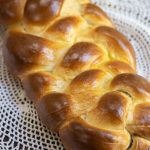
Challah Made with Honey
Servings: 24
Ingredients
For the Challah
- 1 ½ c warm water
- 2 ¼ teaspoon instant yeast see recipe note
- 4 eggs 1 whole eggs + 3 yolks
- ⅓ c honey
- 3 Tb extra virgin olive oil plus a little more for loaf forming
- 2 teaspoon salt kosher or sea salt (I usually use Redmond's real salt)
- 2 teaspoons lecithin optional
- 4 ½ - 7 cups unbleached all-purpose flour divided use
For the Egg Wash
- 1 egg
- 1 Tb water
- 1 pinch salt
Instructions
- To begin, combine the warm water, yeast, egg and yolks, honey, 2 tablespoons of extra virgin olive oil, salt and the lecithin if you're using it. Turn on the mixer for a minute or two to combine these ingredients. Depending upon your style of mixer, you may need to briefly whisk them together.
- With your mixer going with the dough hook, begin adding flour 1/2 cup at a time. You will need at least 4 1/2 cups of flour, but will likely need more. How much you end up needing, will depend upon the moisture in the ingredients, density of flour, and a number of other factors - even humidity in the air. When your dough begins coming together, only add flour a couple tablespoons at a time. Wait in between in addition, to see all of that flour mixed in and watch the consistency of the dough. Once you see a nice, soft dough beginning to come together, allow the mixer to knead the dough with the hook for a few minutes, or until the dough seems nice and elastic.I like to take the dough out as soon as it begins to come together, and knead it by hand the rest of the way on a lightly floured surface. The dough should be soft and elastic, but not sticky.
- Drizzle the remaining 1 tablespoon of extra virgin olive oil in a large bowl and spread it around.
- Form the dough into a nice, smooth ball. Place the dough smooth side down, swirl it around to coat the dough and then set it smooth side up.
- Cover the dough with a damp tea towel and set it in a warm location to rise for 45 minutes or more, until it is doubled in size. The amount of time this takes will depend upon how warm your kitchen is.
- NOTE: My oven has a "dough proofing" setting that creates the perfect warm environment. A sunny location on your counter works great. Another option is to set one of the racks in your oven, on the very bottom setting. Bring a sauce pan of water to a boil. Set the pan of hot water in your oven on the bottom rack. Set your bowl of dough (and later your rising loaf) on the rack above the hot water. This will warm the oven and make a moist environment for the dough to rise as well.
- When the dough has risen, punch it down in the bowl to remove air pockets.
- Drizzle a little more oil onto your counter/table/work surface and spread it with your hands. Turn the dough out onto the surface.
- Roll the dough into ropes to braid into a loaf (or loaves.) I normally do a 4 strand loaf, as it is pretty, and very easy to braid. You can see how I do that in the video linked above in the recipe post.
- Line a baking sheet with parchment paper, and place your loaf on the baking sheet. If you are doing 2 loaves, you will want 2 baking sheets. The challah with expand in size as it bakes.
- Cover the challah again with the damp tea towel (rung out well) and let the dough rise in a warm location, for about 30-45 minutes or until you press on the dough with your finger and the indentation remains.
- Heat your oven to 350°(F).
- While the oven is heating, prepare your egg wash. In a small bowl, combine the egg, water and pinch of salt. Whisk these together until completely uniform (no big blogs of egg white remain.)
- Lightly brush the egg wash all over the top of the challah. (See Recipe Notes below)
- Bake for 20 minutes.
- Pull out the challah, and brush a second coat of egg wash onto the challah. Put it back in the oven, turning the pan around the other way for even baking. Bake for another 20 minutes, 40 minutes total.
- Transfer your challah to a cooling rack and allow it to cool until room temperature or at least just warm. Cutting (or tearing) a hot loaf of bread allows too much steam to escape, leading to dry bread.
- Enjoy!
Video
Notes
Note: If you prefer a lighter, more golden colored loaf, only put one coating of the egg wash on for the second 20 minutes of baking, instead of two coats.
To use traditional Active Dry Yeast you will proof the yeast first. Combine 1/4 cup of the water and the yeast in your mixing bowl, along with 1 teaspoon of granulated sugar. Give it a quick stir to combine and let it rest for 10 minutes. The yeast will become frothy and expand. (If it doesn't, you need new yeast! Don't go any further because you will be wasting your ingredients.) Once the yeast has woken up, add the remaining warm water and continue the recipe as above.
Loaf Forming - See how I braid 4 strand loaves in this video (this is a different challah recipe, but same braiding technique): How to Braid Challah
See This Recipe:
https://cosmopolitancornbread.com/challah-made-with-honey/Equipment Used
- kitchen towel lint-free, dampened
Nutrition
Calories: 132kcal | Carbohydrates: 22g | Protein: 4g | Fat: 3g | Saturated Fat: 1g | Polyunsaturated Fat: 0.5g | Monounsaturated Fat: 2g | Trans Fat: 0.004g | Cholesterol: 34mg | Sodium: 210mg | Potassium: 51mg | Fiber: 1g | Sugar: 4g | Vitamin A: 50IU | Vitamin C: 0.03mg | Calcium: 10mg | Iron: 1mg
